
Bristol, England · June 1635 — Pemaquid Point, Maine · August 1635
Crossing the Atlantic, 1635
The voyage of the Angel Gabriel — how the Blaisdell family crossed an ocean, survived a hurricane, and arrived at the shore that would define their family for four centuries.
Departed Bristol
June 4, 1635
Boarded at Milford Haven
June 9, 1635
Arrived Pemaquid Point
August 14, 1635
Ship Destroyed
August 15, 1635
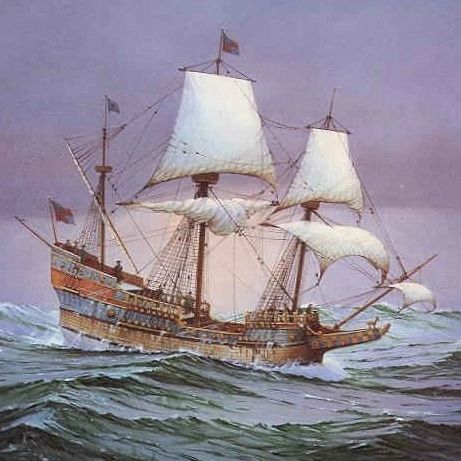
Drawing of the Angel Gabriel, the Bristol merchantman that carried the Blaisdells to America
The Angel Gabriel
The Great Migration, 1630–1640
A Family Crosses an Ocean
"On the evening of August 14, 1635, the Bristol merchantman, conveying settlers and supplies to the New World, wrecked in a hurricane near the Pemaquid (Maine, U.S.A.) settlement. Before this study, little was known of her, except her tonnage, approximate ordnance, and the names of a few of the passengers on her last voyage."
In the summer of 1635, a Bristol merchantman called the Angel Gabriel set sail for the coast of Maine carrying settlers, supplies, and the hopes of dozens of English families. Among them were Ralph Bleasdale — wool trader, Puritan, and the man who would become the progenitor of every Blaisdell family in America — his wife Elizabeth Parker, and their young son Henry.
What followed was one of the most dramatic arrivals in the history of the Blaisdell family: a nine-week ocean crossing, a safe landfall on the coast of Maine, and then, within hours, the destruction of their ship in the most powerful hurricane to strike New England in the seventeenth century.
The World They Left Behind
By the 1630s, England was a nation under strain. The reign of Charles I had brought mounting conflict between the Crown and Parliament, and the Puritan community — already subject to religious persecution under Archbishop Laud's campaign to enforce Anglican conformity — faced an increasingly hostile climate. For men like Ralph Bleasdale of Lancashire, a devout Puritan and wool trader, the calculus was becoming clear: the New World offered what the Old World was rapidly closing off.
The Great Migration of the 1630s saw tens of thousands of English Puritans cross the Atlantic to New England. Between 1630 and 1640, an estimated 20,000 settlers made the crossing. Ralph Bleasdale and his family were among them — part of a deliberate, organized movement to build a godly society in the wilderness of North America.
The Angel Gabriel: Ship and Cargo
The Angel Gabriel was a Bristol merchantman of approximately 240 tons burden, armed with ordnance and fitted to carry both passengers and cargo. She had a history of Atlantic and coastal voyages before her final crossing. In 1618, she had ventured as far as South America on an earlier adventure. By 1635 she was a seasoned vessel, well-known in Bristol's merchant circles.
Her final voyage carried settlers, supplies, and livestock bound for the English settlements of coastal Maine. The passenger manifest included families from across the west of England — Puritans, tradesmen, and their children — all staking their futures on the promise of a new life. Ralph Bleasdale, his wife Elizabeth Parker, and their three-year-old son Henry were among them. Ralph boarded not at Bristol but at Milford Haven, Wales — a deliberate choice to avoid the scrutiny of the more closely watched Bristol docks, where authorities were increasingly alert to Puritan emigration.
Seventy Days at Sea
The crossing from England to New England in the seventeenth century typically took between six and twelve weeks, depending on winds and weather. Passengers lived in cramped, dark quarters below decks, sharing space with livestock, provisions, and cargo. Fresh water was rationed. Disease was a constant threat. The Atlantic in summer could be deceptively calm for weeks, then turn violent without warning.
Rev. Richard Mather, who crossed the Atlantic in 1635 aboard a different vessel, kept a detailed journal of his voyage that gives a vivid picture of what such crossings were like: the terror of storms, the relief of calm seas, the daily prayers and sermons that sustained the passengers' spirits. For the Bleasdale family, the crossing lasted roughly nine weeks — from their boarding at Milford Haven on June 9 to their arrival at Pemaquid Point on August 14, 1635.
The Great Colonial Hurricane
The Angel Gabriel arrived at Pemaquid Point on the evening of August 14, 1635, and her passengers came ashore. They had survived the crossing. They had arrived. The ordeal, it seemed, was over.
It was not. In the early hours of August 15, 1635, one of the most powerful storms in the recorded history of New England struck the coast of Maine. The Great Colonial Hurricane — known also as the Hurricane of 1635 — made landfall with catastrophic force. Contemporary accounts describe winds of extraordinary violence, a storm surge that swept inland, and widespread destruction from Virginia to Nova Scotia. The Angel Gabriel, still at anchor in Pemaquid Harbor, was torn from her moorings and destroyed. The passengers had escaped with their lives. Their possessions, their provisions, and the ship that had carried them across the ocean were gone.
The wreck of the Angel Gabriel has never been definitively located. Archaeological searches in 1977 and 1978 found evidence consistent with a seventeenth-century wreck in Pemaquid Harbor, but the ship herself remains elusive beneath the waters where she sank nearly four centuries ago.
Ashore at Last: Pemaquid Point
The Blaisdell family found themselves on the rocky coast of Maine with little more than the clothes on their backs. Pemaquid was a small but established English settlement — one of the oldest in Maine — with a handful of houses, a trading post, and the beginnings of a community. It sat at the northern edge of English land claims, bordering French territory, and was subject to the tensions and dangers of that frontier position.
Ralph and his family did not remain long at Pemaquid. Within a few years they had moved south to York (then called Agamenticus), and by 1640 Ralph had settled in Salisbury, Massachusetts, where he became one of the town's 69 founding fathers. But Pemaquid Point remained the place where the Blaisdell story in America began — the shore where Ralph Bleasdale first set foot on the New World, the harbor where the Angel Gabriel was lost, and the spiritual home of the family for nearly four centuries since.
Ongoing Research
The Search for the Angel Gabriel
The BFNA cooperates with historical and maritime groups interested in recovering and raising the Angel Gabriel. Field searches were conducted in 1977 and 1978; the ship was not located, but valuable data was collected. The BFNA also cooperates with the Maine Historical Society to preserve Blaisdell items. Periodic updates appear in the Blaisdell Papers.
Source: Warren Curtis Riess, Angel Gabriel: The Elusive English Galleon. Research conducted in New England and English archives, 1977–1978.
Continue the Story
Related Stories
The Angel Gabriel
The full account of the Bristol merchantman — her history, her cargo, and the search for her wreck.
Pemaquid Point
The rocky Maine shore where the Blaisdells first set foot in America — and where the Angel Gabriel was lost.
Who Was Ralph Bleasdale?
A full portrait of the Blaisdell patriarch — his Lancashire origins, Puritan faith, and life in colonial New England.
The Family Patriarch
R. Carter Blaisdell's account of Ralph's life from Lancashire wool country to Salisbury founding father.
Journey of the Blaisdells
The full four-century chronicle — from the first parish record in 1559 to the founding of the BFNA in 1935.
The Blaisdell 37
Explore all 37 documented spelling variants of the Blaisdell name across four centuries and two continents.
Descendants of the Angel Gabriel
You Are Part of This Story
If you carry the Blaisdell name — in any of its 37 spellings — you are a descendant of Ralph Bleasdale, who stepped ashore at Pemaquid Point on August 14, 1635. Join the BFNA to connect with your family and preserve this history for future generations.